A geologist, a Young Earth Creationist, and a standoff over 1.2 billion missing years
The challenge came from a man named Floyd Waters.
It happened deep in the magnificent Grand Canyon of the Colorado River, where our rafting expedition took a side hike into Blacktail Canyon. As a former professor, I looked forward with great excitement to the prospect of explaining a fundamental principle of geology.
I pointed to the canyon wall and explained: “Here we see 508‑million‑year‑old Tapeats Sandstone resting directly on top of 1.7‑billion‑year‑old Vishnu Schist. This line in the cliff face is called the Great Unconformity. It represents a time gap of nearly 1.2 billion years. Think of it as a history book where a thousand pages have been ripped out. We jump straight from the dark, twisted basement rocks to the flat ‘layer cake’ of sandstone on top, missing a billion years of story in between.”
During this immense span of time, the Vishnu schists were formed in the core of an ancient mountain chain, then uplifted and eroded before being submerged under the waves of an encroaching Cambrian sea.
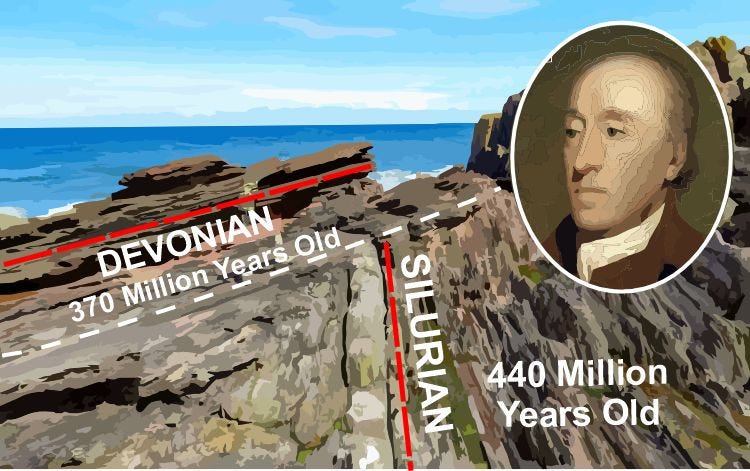
I continued, warming to my topic: “Back in 1788, the Scot, James Hutton observed a similar unconformity at Siccar Point on the east coast of Scotland. This inspired him to conclude that 6,000 years is far too short a time to harden, tilt through 90 degrees, and erode Silurian rocks before depositing Devonian sandstones. Hutton came up with the concept of “deep time.”
I was about to compare Hutton’s breakthrough with the legendary experience of Archimedes, and with Galileo’s observation of the moons of Jupiter — both representing Eureka moments in the history of science — when my reflections were interrupted by an authoritative interjection:
“In Genesis, the Bible tells us that this line marks the start of the Flood — the moment the fountains of the great deep broke open and scoured the pre-Flood earth.”
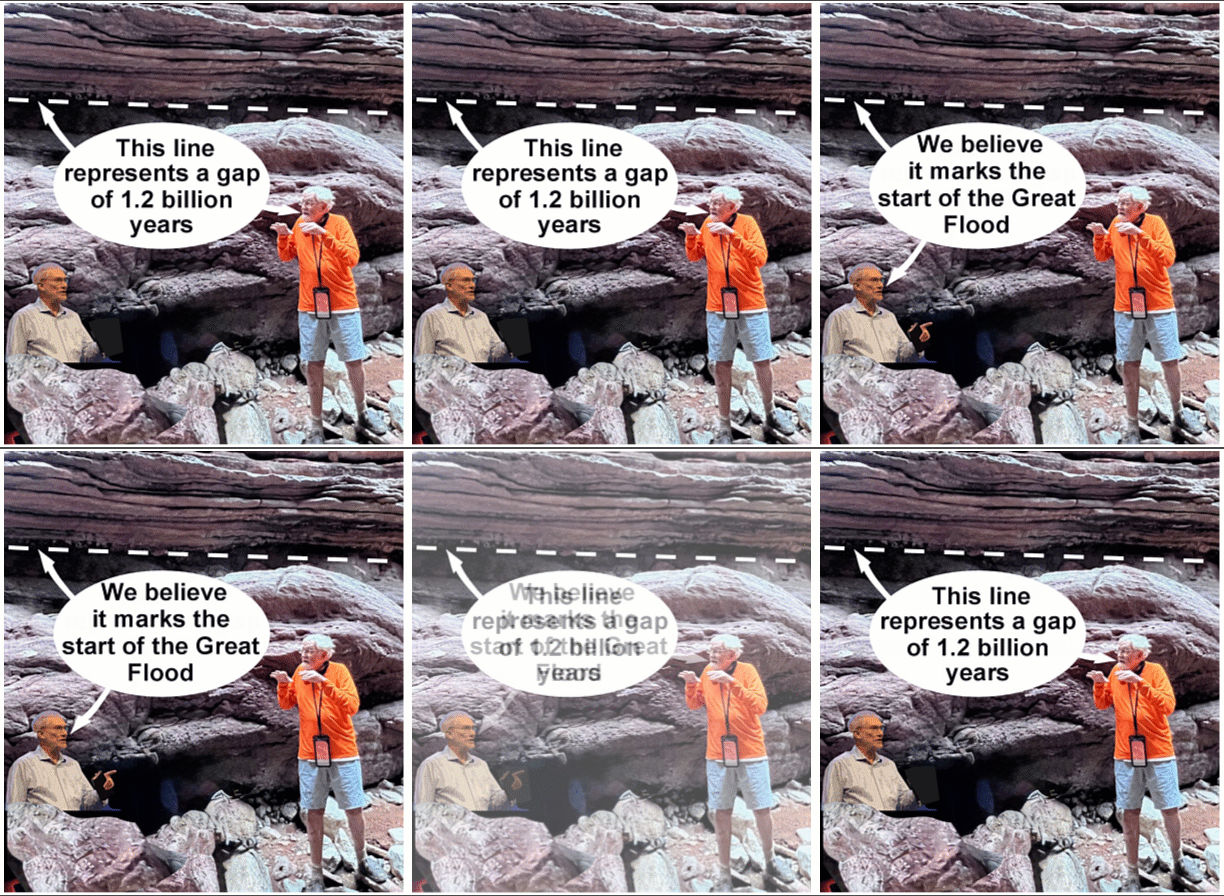
A name tag identified my challenger as Floyd Waters, from Branson, MO — a resident of the Bible Belt. A Young Earth Creationist (YEC) with the bright, wide-open eyes of someone who was the beneficiary of privileged knowledge.
Silence fell over the audience.
Thirty pairs of eyes darted between me and Mr Waters. How should I have reacted? Should I have been kind or indignant? Compassionate or contemptuous?
I played for time with a diplomatic response:
“Thank you for reminding us about the power of myth. Worldwide floods are staples of most ancient religions, together with virgin births and resurrections.”
“Did you know that the ancestral inhabitants of these very canyons — the indigenous Navajo and Hopi — have origin stories that involve flooding? For the Navajo (Diné) the First World is destroyed by a great wall of water because of the sins of the Insect People, forcing the emergence to the Second World.”
I turned my attention to the wider audience. “The Bible is a wonderful book, but most scholars regard creation accounts as myths rather than literal truth.”
My antagonist doubled down. “We take Genesis literally. If we compromise on scripture, we undermine the theological framework of the entire Christian faith.”
My hand was forced; Floyd had thrown down an ideological gauntlet. I wondered whether to dial down the rhetoric for the sake of social cohesion or to fight back. Perhaps this was a teaching opportunity, a moment to demonstrate the scientific method in the spirit of the Enlightenment.
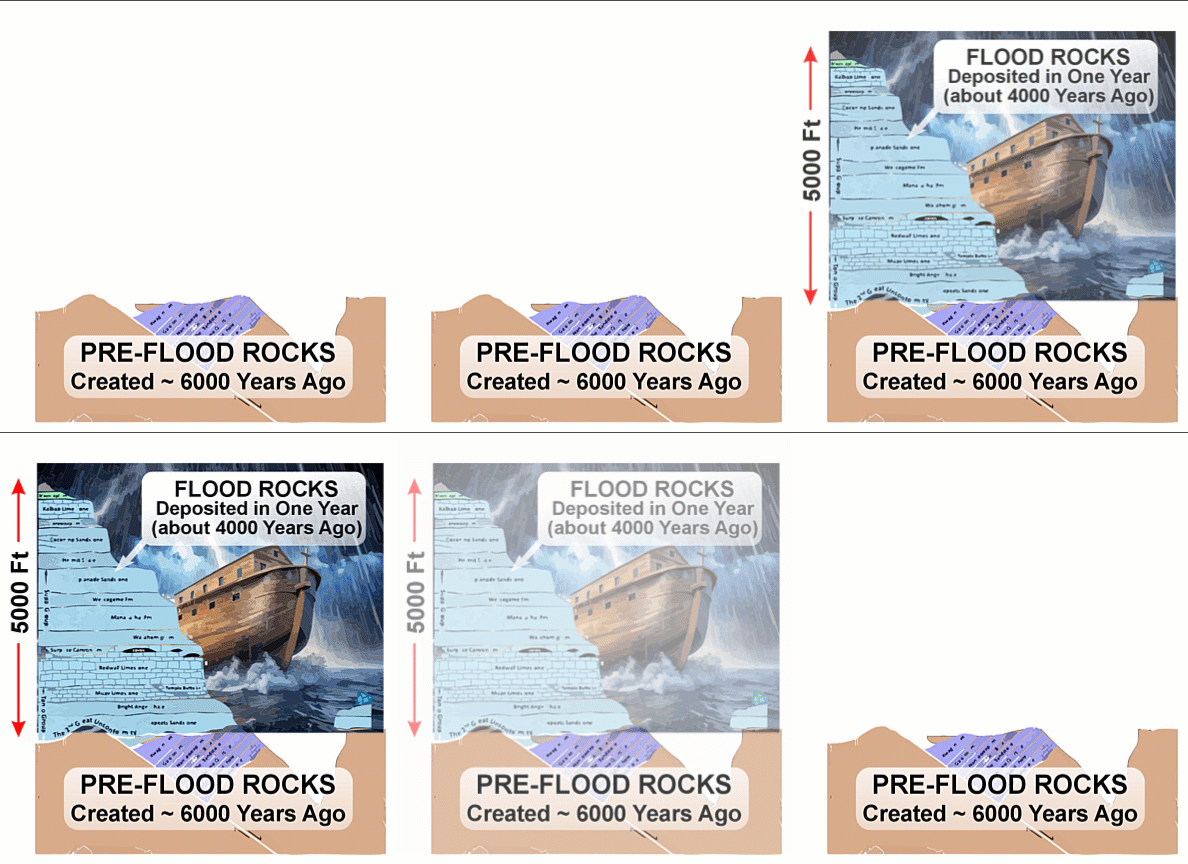
YECs believe the geological record is the outcome of two events: an act of creation, followed by a worldwide flood. In this view, all the Paleozoic rocks in the Grand Canyon were laid down in a single year about 4,000 years ago.
In my mind, I cataloged the mountains of evidence that contradicted his timeline. I could have pointed to the ancient bristlecone pines that were alive and growing centuries before his calculated date of the Great Flood. I could have described the ice cores in Antarctica that preserve an unbroken annual record of 800,000 winters, or the slow, grinding movement of tectonic plates that requires eons, not days, to separate continents. Above all, there was the atomic clock of the Earth itself — radiometric dating — which proves our planet is 4.5 billion years old.
But I hesitated. I knew that for Floyd, these weren’t data points to be analyzed; they were tests of faith to be withstood.
I anticipated the mental gymnastics required to deny this. To explain away the atomic evidence, YECs have to claim that radioactive decay sped up a billion-fold during the Flood. It is a desperate theory that requires rewriting the fundamental laws of physics — altering the speed of light and Planck’s constant on a whim.
And the thermodynamics? If they were right, the heat released from such hyper-accelerated decay wouldn’t just warm the planet; it would have melted the crust and boiled the oceans into steam. If Floyd’s timeline were true, the very rocks we were standing on would have been reduced to molten slag.
In the battle of reason against faith, my expectations were of failure. If the chances of changing Floyd’s mind were unlikely, why did I bother?
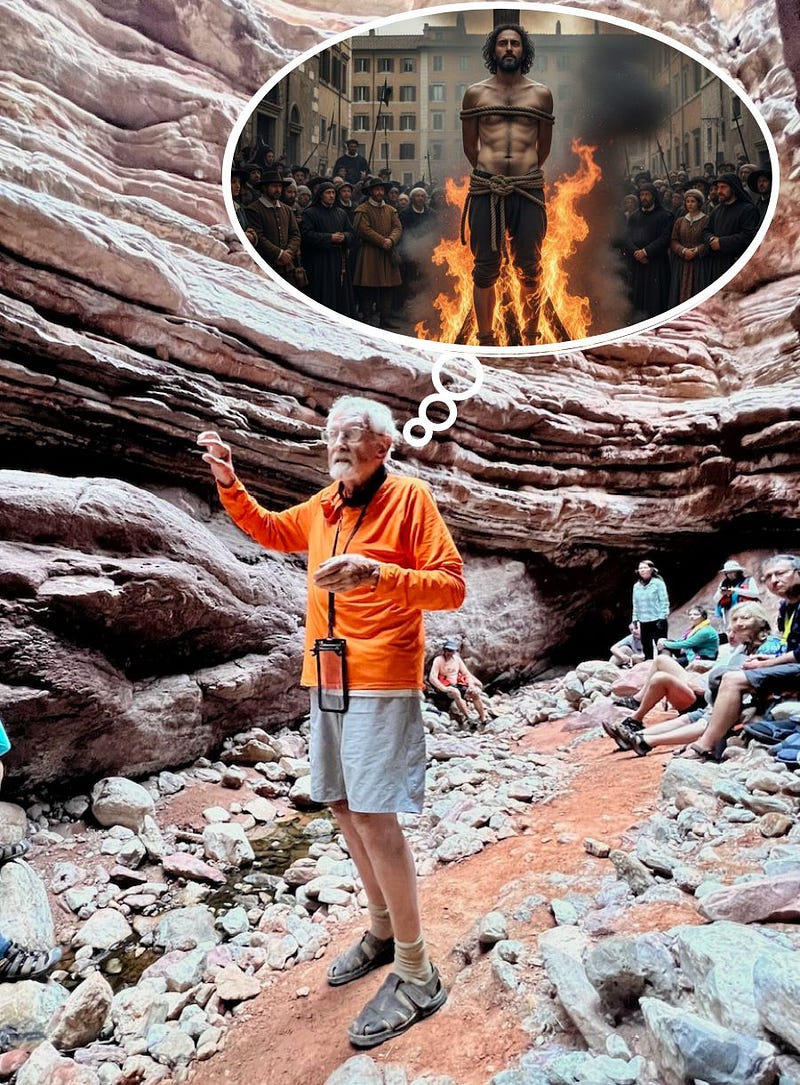
I thought of my responsibility to the truth and my solidarity with fellow scientists. Was I brave enough to tell the truth — like Giordano Bruno, who was burnt at the stake in the Campo Fiori in Rome for espousing the Copernican view? Or would I cave in as Galileo did when threatened with the Vatican’s instruments of torture?
What about my moral responsibilities? I noted the two teenage boys in the group, their prefrontal cortices doubtless still underdeveloped. Should I shield them from proselytization, or was that a parental responsibility?
Solidarity with fellow geologists ignited my righteous indignation. Comrades in geology, sisters and brothers united in intellectual curiosity — collecting rocks in dangerous conditions, from volcanoes, and glaciers, in swamps, jungles, and deserts. Teams comparing data across continents, generations building on each other’s work, analyzing samples at midnight in lonely laboratories, toiling in obscurity, uncorrupted by ideology or dogma, motivated entirely by the search for truth.
How dared these ideologues write off their efforts in such a cavalier manner? With universal truth at stake, the question was: how dared I not push back?
I decided on a straightforward appeal to common sense: “The Bible is a remarkable cultural document. But using it as a geology textbook is like using a cookbook to repair a jet engine.”
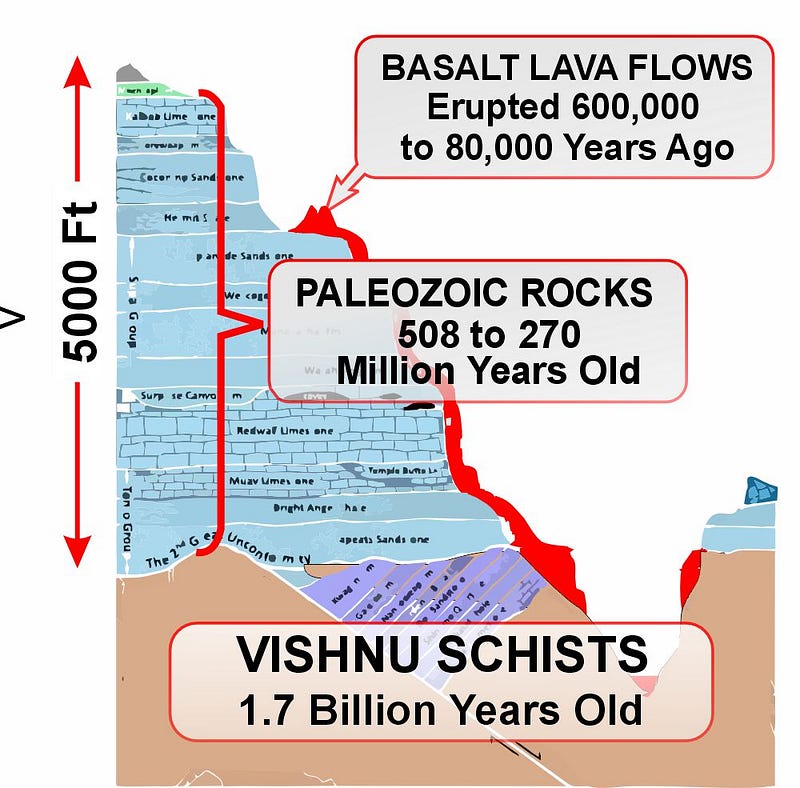
I pointed again at the Great Unconformity. “Look,” I told the group, “this isn’t rocket science — it’s just common sense. You can’t fold billion‑year‑old rocks, tilt them sideways, erode them into a flat surface, and then deposit 5,000 feet of younger layers on top — all in a few thousand years. Nature simply doesn’t work that fast.”
Floyd shrugged. “I’d rather stand on the unchanging word of God than on the ever-shifting theories of men who weren’t there to see it happen.”
Just then, a raven landed on a ledge of sandstone above us, its feathers as black as the schist below. It let out a single, hollow kronk that echoed off the canyon walls. Floyd looked up, seeing a sign; I looked up, seeing a scavenger descended from the avian dinosaurs. We stood there, anchored by our opposing views, while the bird simply stared — perfectly indifferent to the missing billion years lying beneath its claw.
John Wakefield holds a Ph.D. in geology and is a former university professor. After a 38-year detour running an art glass business, he is now 80 years old and traveling the US, with his wife Claire, in a minimalist RV named “Diogenes.” He writes about deep time, history, and life on the road. You can follow his adventures on YouTube.