

How a legendary basketball coach’s obsession with socks led to a miracle on a youth soccer field.

I have always loved how soccer belongs to everyone. A soccer stadium is one of the few places where the person sweeping the stands and the person owning the building can scream with exactly the same desperation and joy.
Outside the United States, it is simply football — the world’s game. Its beauty lies in its simplicity: all you really need is a ball and an improvised goal made from backpacks, shoes, or piles of discarded clothing. From the beaches of Rio to cramped city alleys, kids have always found somewhere to play.
For many people, the game becomes more than a sport. As Albert Camus — Nobel Prize-winning author and former goalkeeper — once said:
It was with this kind of appreciation for the game that I took on the job of coaching the Rincon Rangers, an AYSO team of eight-year-olds in Tucson.
At that age, the beautiful game looks less like organized sport and more like a minor riot. Players swarm around the ball like bees around a soda can. Strategy is nonexistent. In our early games, some of my players regularly forgot which direction we were attacking and enthusiastically blasted the ball toward our own goal.
To fix this, I needed advice from the best. So, I turned to one of America’s greatest coaches: John Wooden, the “Wizard of Westwood.”
The Wooden Way
For anyone unfamiliar with basketball history, John Wooden coached the UCLA Bruins to ten national championships, including a ridiculous streak of seven straight titles. No men’s team has come remotely close since.
Wooden famously spent the first practice of every season teaching his players how to put on socks and tie their shoes properly. His logic was simple. A wrinkle in a sock causes a blister. A blister keeps a player out of practice. Missed practice hurts improvement. A player who cannot practice cannot help the team, and a loose shoelace could sabotage a buzzer-beater finish.
As Wooden put it:
“Little things make big things happen.”
I was struck by the humility of it: titans like Lew Alcindor and Bill Walton sitting in silence, listening to a lecture on socks for the good of the team. It proved that in any game worth playing, you have to be grounded in the dirt before you can reach for the sky.
The Throw-In Lesson
Following Wooden’s philosophy, I decided our version of “learning to tie your shoes” would be the throw-in.
A throw-in sounds simple until you try teaching it to eight-year-olds. The player has to face the field, use both hands, bring the ball from behind and over the head, and keep both feet touching the ground while releasing it. You cannot just fire it like an NFL quarterback launching a pass.
Simple in theory. Much harder in practice.
We spent a couple of weeks at Lineweaver Elementary School drilling throw-ins over and over until the movement became automatic. Once the muscle memory was in place, we moved on to tactics.
I preached one rule constantly:
“Always throw down the line – never throw infield”
Throwing parallel to the sideline is the safest option because losing the ball near the center of the field is dangerous. The sideline acts like an extra defender.
To make the point stick, I told them about Super Bowl XVIII. With seconds left in the first half, Washington quarterback Joe Theismann threw a sideways screen pass. Raiders linebacker Jack Squirek intercepted it and ran it in for a touchdown. Game over.
A different sport but the same principle. Eight-year-olds may not understand tactical positioning, but they understand disaster.
The Miracle in the Wind
Game day arrived with one of those classic Tucson winter winds that seem determined to move everything not nailed down.
The field was dry and hard from the Arizona sun. Tumbleweed skittered across the grass as the wind blew straight down the pitch from west to east.
We won the coin toss and, on my instructions, chose to play into the wind during the first half. It was ugly, desperate soccer. Every time our keeper tried to punt the ball, it seemed to hit an invisible wall and hover, before dropping right back where it started. We were pinned in our own half, blinking against the gale, but somehow we survived without conceding a goal.
Then came the second half.
Now the wind was behind us.
We earned a throw-in on the right touchline, about thirty yards from the opponent’s goal. Up stepped José.
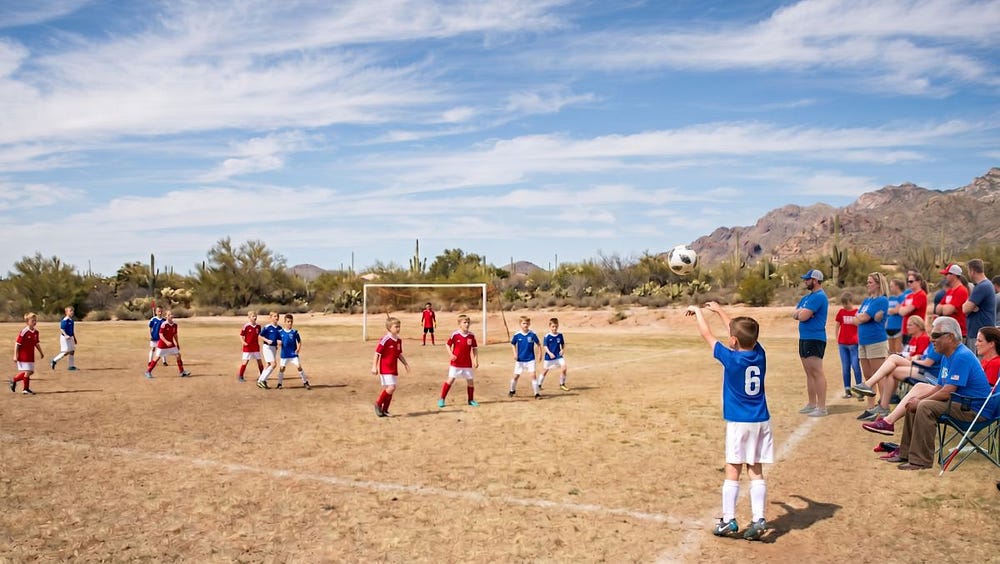
He did exactly what we had practiced. Short run-up. Proper form. Ball thrown firmly down the line.
Then chaos took over.
Junior soccer balls are incredibly light, and our field was full of bumps and divots. José’s throw hit one of them perfectly, bounced sideways toward the infield, and suddenly the wind grabbed it.
The ball began swirling and hopping toward the goal like something with a mind of its own. It picked up speed as it entered the opponent’s penalty area.
A defender panicked, flailed at it, and sliced the football sideways into his own net.
A goal cannot be scored directly from a throw-in, so José needed that final touch from the defender for it to count. It was ridiculous luck. But it was also the direct result of the throwing routine we had practiced again and again.
For a coach, moments like that feel triumphant. Not because of the scoreline, but because you see preparation turn into a successful outcome right in front of you.
But what I remember most happened afterward.
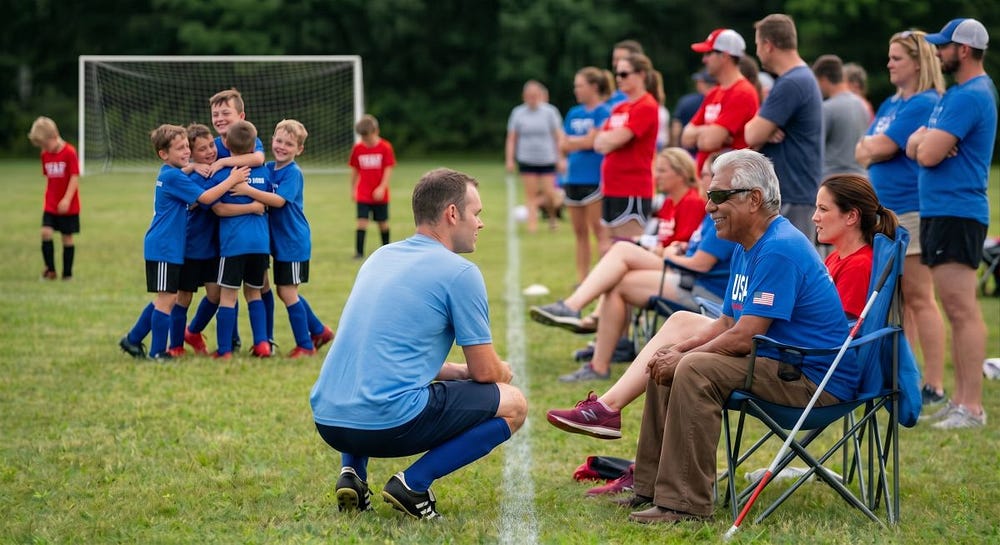
As parents cheered along the sideline, I crouched beside José’s grandfather. Even without seeing the field, he closely followed every shout from the boys.
In pidgin Spanish, and with far more enthusiasm than grammatical accuracy, I explained what had happened.
“¡Muy bueno trabajo — José metió un golo de un saque de manos!”
José had scored from a throw-in.
The old man broke into a smile.
He didn’t see the ball hit the net, but he heard the chorus of shouts as the team swarmed José in celebration. He could sense the excitement in his grandson’s voice and feel the happiness all around him.
And standing there in the Tucson wind, I finally understood what Wooden meant.
Greatness is rarely one spectacular moment. Most of the time, it comes from repeating small things carefully and consistently until they become part of you.
Little things do not just make big things happen.
In the end, they are the big things.
John Wakefield is a retired exploration geologist and university professor who now travels the United States in a truck camper named Diogenes. A former business owner and lifelong observer of history and sport, he writes about the intersection of discipline, legacy, and the unexpected moments found on the road. When he isn’t writing for Medium, he can be found cheering for Arizona basketball and Leeds United.
My Portfolio & Travels: linktr.ee/jwakeart